
Many thanks to Thomas, Paloma and Natalia for your thoughtful and critical read <3
This piece is part of a series on how our profession is navigating the crises it faces.
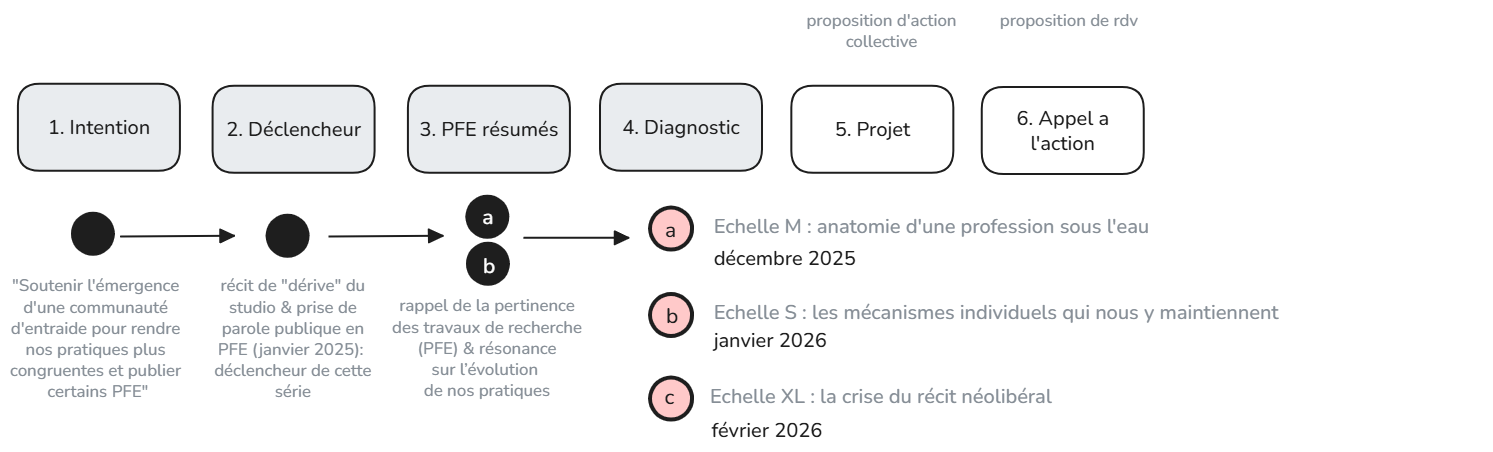
_Progression diagram & links to previous emails: _1 _, _2 _, _3a _, _3b
Warning: this text diagnoses a critical aspect of our daily lives. It puts words to situations that aren’t always easy to name or see. The reading may feel unsettling at times. If you’re already near the breaking point, read at your own pace — or come back to it later. The intention of this diagnosis is to untangle the complexity of our situations and reclaim some power over them. It only makes sense if it becomes collective, enriched by your own perspective.
The text is long — you can also listen to it as a podcast!
Our profession isn’t struggling by accident: it’s a symptom of a system that’s cracking. We’re holding up in a profession that is structurally underwater — humanly and economically untenable, so far from its “public interest” vocation that it pushes us to burnout. What keeps us in this toxic relationship — and what might offer a way out that isn’t every person for themselves?
First, we’ll layer together the main causes of the crisis our profession is facing (part 1, scale: M), then identify some of the mechanisms that keep us locked into toxic practices (part 2, scale: S) and finally try to shed light on the complexity of the current polycrisis (part 3, XL) — to trace a path of renewal grounded in this systemic diagnosis and our research (email 5, coming soon).
I. Architecture: anatomy of a profession underwater
The causes of the crisis — scale: M — profession
Dear all,
In trying to understand why we haven’t published our research — work that could genuinely reinvent our practices, contribute to a nauseating public debate, and restore some of the social purpose of our discipline — I started looking for what seemed to me the causes of our paralysis. Which is to say: having our heads structurally underwater.
Why begin with this painful account of our difficulties, instead of presenting the collective mutual-aid project I ultimately want to build? Because this is our subject. Not one individual’s. Not top-down. The intention is to act together, and the process matters as much as the outcome. To build something collective, we need to open a space where we name our situations — which I believe are untenable — and cooperate to create solutions we can invent and own together. To my mind, that is far more empowering than “delivering” a ready-made answer.
The goal of these texts isn’t only to publish our graduate research — it’s first to step away from toxic practices. And the two are deeply linked.
Five years after graduating (one year as an employee, three years on my own, and one burnout), and more than two years of activism (the OFQA collective, born out of the mobilization of the national architecture schools ENSA in 2023–2024, co-organizer of the Architecture Professions Forum (ENSAPB, 2024), member of the APB alumni association board), and thanks to extensive research and six months of writing, I’ve come to see that what I’m experiencing is not an individual failure. It’s the conditions of a profession that is structurally underwater and estranged from its public-interest vocation that are wearing me — wearing us — down. That realization is what motivated me to go through this research and share these writings with you. Enjoy the read.
The post-graduation transition — a full split
The historical gap between academia and the profession is in theory a guarantee of independence and mutual reinvention. Training embodies the ideal of our discipline (social, political, systemic, critical vocation), while practice means dealing with the material world and all its constraints (legal, administrative, economic, technical, temporal). These two poles are complementary — but we can ask ourselves about the transition between them, and how they actually connect.
A personal account
- The post-graduation transition felt like disorientation. A lack of clarity and means to build a professional practice that fit my values and my research; a trade to learn almost from scratch and alone; which ended in burnout. And a sense of injustice, waste, indignant anger, and sadness.
- Working conditions are brutal: high responsibility and chronic stress are my daily reality — oddly uncoupled from pay, which leaves me fairly precarious. The absence of support from my professional body reinforces the pressure and normalizes the loneliness of a trade learned through trial and error.
- I keep questioning the meaning of my work. Eco-anxious or eco-lucid, I work on standard projects that feed a construction industry I don’t endorse, and I wonder about my contribution to the ecological transition and the social purpose of what I do. For now, the answer is unsatisfying. I feel an uncomfortable gap between my profession and what I briefly touched during school — that sense of “social utility” — which I don’t live in my actual work.
A community-level account:
- Many architects engage in civil society networks and alternative approaches (collectives, reclaimed materials, bio-based building, sustainability…) to shift practices. Yet there is little to no mutual support between colleagues to avoid the dispersal and burnout that threatens at the slightest excess of responsibility and fatigue.
- The Paris Belleville alumni association (APB), designed precisely for this kind of support (which technically we all belong to), is depleted, on standby. There’s little help to expect from that side today — though it’s worth investing in! That’s part of the project :)
- Almost nothing has been published from our former studio to date — despite 10 years of teaching and over 400 students — and despite the intelligent, critically acute work produced, proposing pathways for transforming our social systems that are painfully relevant right now. A tragedy for the common good?
An institutional account:
- The engaged, critical teachers who trained us maintain the historical academy/profession divide for research purposes. But knowing the realities of practice — why not support the landing of such disruptive graduate theses? My hypothesis is that they, more than anyone, are underwater (teachers, practitioners, parents — a chronic overload, no support infrastructure), and despite themselves perpetuate the paradox of individualism at the heart of building the common good. Their difficulties become ours, when these mentors have not — or so rarely — undertaken collective publishing efforts. No doubt because the academy/profession gap is too wide, and their own practices sometimes seem incongruous with their teaching (public contracts, urban development projects). And though their teaching is genuinely compelling, they’ve also passed down the all-nighter culture and an elitist sensibility — a blind spot in their otherwise critical spirit?
- HMONP (the French professional qualification for architects — roughly equivalent to ARB registration in the UK or licensure in the US): our only professionalization training strongly emphasizes entry through public procurement (market tenders, the MOP law governing public building projects, competitions, PPPs). Yet according to the MAF figures 2021 [1], public procurement accounts for only 26% of the project value architects oversee; meanwhile, roughly two thirds of the profession work in individual structures oriented toward the private sector. This pedagogical bias feeds the reproduction of an elitist, minority set of norms and imaginaries (large-scale programs, competitions), far removed from the day-to-day reality of most practitioners (SFA, 2020) [2]. Given the crisis in the profession, the priority should be clear: train people to fine-tune partial missions (advisory, project management, private contracts), rather than forcing the public procurement framework onto every situation.
- Incubator? When the school, pushed by higher education reform, creates an incubator/accelerator (a post-graduation support structure, like échelle Un at éav&t or Banc d’essai at ENSAPLV), it does so in conditions unlikely to improve the situation (mostly older faculty, no recent graduates on the committee, with me representing APB as the sole “consulted” party) — concluding (for now) that the goal is to help established firms develop prestigious research projects. Not to support most young graduates in transitioning to professional life. Not to bridge the academy/profession gap that is, I’d argue, the source of the post-graduation malaise.
Who benefits from this near-absence of connection between school and professional life? Presumably the profession, which can then freely shape young architects into a trade whose working conditions are deeply problematic. How did we get here?
Disproportionate responsibility: a slow suffocation
Our profession has experienced a slow drift over nearly a century. By trading one monopoly for another (from building contractor to the monopoly on signing building permits) (cf. the Guadet code 1895[3], confirmed by the Architecture Act n°77-2 of 3 January 1977)[4], what may have seemed a fair compromise has transformed, decade after decade, into a deterioration of working conditions. Risk, responsibility, and ethics on our side (the architect/project manager); benefits, the protection of the non-expert, and power on the side of capital holders (the client). (See Isabelle Chesneau’s work on the subject of professional responsibility and the sociology of the profession.) We are caught in the grip of an unequal power dynamic. This responsibility translates notably into the sum of our professional order and insurance dues. As a proportion of our average income, this burden is the second highest of all regulated professions in France, behind lawyers (4% of revenues on average) (see calculation note)[5].
We absorb the system’s tensions. Beyond this insurance and financial burden, we absorb regulatory inflation, growing technical complexity, economic pressure (and the evolution of the market toward instability, with uncertain payment timelines), the growing need for coordination between specialists, and documentary pressure (tender documents, visa approvals, post-construction files, traceability) — which shifts time away from actual design toward procedure. Stuck at the crossroads of ever-increasing complexity and performance demands, we constantly adapt — plugging gaps, patching holes. We carry the lion’s share of the mental load of project management. And unlike a standard company, we don’t declare bankruptcy. No. We hold on. We work indecent hours. We sacrifice our health, our relationships, our balance to save projects that are sometimes far beneath our vocation of public interest.
We sacrifice our health to the point of burnout. This silent epidemic we so rarely talk about. There are no specific burnout statistics for French architects — no institution has conducted that specific research. The Ordre (the professional body) does identify — without going further — that the primary difficulty in practicing is “work intensity and time pressure,” according to 82% of respondents (Archigraphie 2024[6]). The only academic benchmark on mental health comes from the Australian Institute of Architects, in a 2023 survey of 2,066 respondents: approximately two thirds of practitioners reported at least some level of psychological distress, more than one quarter reported moderate to severe distress, and 42% felt their work negatively impacted their wellbeing. Only 1 in 10 practitioners had experienced no psychological distress at all. The study points out that the factors are not (only) individual but structural: overload, compressed deadlines, insufficient fees. (Parlour, 2023) [7]. The study concludes that the solution is to change the culture of practice.
And the most brutal part: that sacrificed energy doesn’t serve an emancipatory project. It serves an industry that damages what we claim to serve and protect — the common good.
Sacrificing our health in service of destroying the living world
The sector we serve is among the most destructive on the planet. Buildings and construction account for roughly a third of global CO₂ emissions (UN/UNEP [^10]).
Built around the dominance of concrete, the current construction paradigm was born in the post-World War II era. Concrete’s capacity for industrialization enabled its meteoric rise during the war and Reconstruction, promoted by the modernist avant-garde and endorsed by the state. Today, more than three quarters of new collective and commercial buildings are built in concrete (FFB, 2020[8]) — a monoculture that benefits four groups capturing 80% of the sector’s revenue (Xerfi, 2025 [9]).
Concrete — this ingenious “liquid stone” — is not the problem in itself. It’s the social structure that has been built around it, a metaphor for the industrial and capitalist logic of the “modern” world. We’ll return to that later (Part III) when we look at the deeper logic this material carries — what we might call the Capitalocene.
This hegemony rests on several interlocking locks:
- Normative and insurance lock-in. Structural calculation rules, technical standards (the DTU framework), insurance systems, and economic models are written “for” reinforced concrete. Alternatives have to constantly prove they’re not dangerous, while concrete is presumed innocent by default (Soulèvement de la Terre, 2025 [10]). The industry does everything it can to slow any change, dangling “low-carbon cements” that in reality do nothing to alter the extractivist logic of the industry or its carbon footprint — the classic techno-capitalist greenwashing (Mouvements, 2022)
- Systematic socialization of damages. Workers’ health, the programmed obsolescence of large housing estates, land artificialization: the costs of low-quality, rigid construction are systematically socialized — paid by residents, local authorities, and healthcare systems — while profits remain captured by a handful of major corporations subsidized by public funds. The billions spent on ANRU demolitions (the national urban renewal program) haven’t resolved the precariousness of the neighborhoods (Epstein, 2013) [11]. A double penalty: stripping residents of agency over the evolution of their housing, while making them pay the maintenance and renewal costs of an alienating environment.
- Social organization of construction sites. Concrete goes hand in hand with an industrialization of the building site that strips workers of their skills: rigid hierarchies, precarious labor, exploitation of vulnerable people (migrants), brutal rhythms, safety rule violations for optimization purposes, work-related diseases (Jounin & Braud, 2016 [12]).
- Extractivism and neocolonialism. Concrete depends on raw materials extracted from the Global South: sand, aggregates, clinker, fossil energy. The industry offshores the dirtiest parts of the chain (clinkerization, pollution, occupational diseases) to former colonies while selling a “green” veneer in the North. A colonial logic that renders invisible numerous human rights violations and environmental pollution — or even, at times, complicity in crimes against humanity, as in Jalabiya, Syria. (see the Greenpeace Switzerland 2020 report on LafargeHolcim[13]). This constructivist logic is unsustainable — sand is already running short. The UN 2022 report recommends ending concrete use by 2050 — an absurd situation given the millions of vacant buildings available to renovate, the vast existing built stock that needs retrofitting, and the tonnes of construction waste awaiting reuse.
On the other side, wood, earth, plant-fiber and broader bio-based material supply chains combine biogenic carbon storage with local resources and vernacular know-how. They could profoundly transform our practices and those of entire territories. But their uptake is blocked: concrete industry lobbying, supply chains deemed “immature,” incomplete insurance and regulatory frameworks (sources: Ministry of Agriculture, Cour des Comptes, Cerema [14]). While entire graduate theses demonstrate the feasibility of these approaches[15], public and private clients — and architecture schools — continue to mostly feed the concrete monoculture.
In other words: we wear our bodies out in a practice that, by design, damages the bodies of other workers, displaces residents from neighborhoods it has itself degraded, and destroys the ecosystems on which life depends. The question is no longer how to “green” the industry — it’s how to exit an industrial model that’s driving us straight into a wall.
Meanwhile, the value created flows elsewhere.
In a sector that represents 20% of French GDP [16] (5% construction, 15% real estate), every intermediary takes their cut: developers, real estate agents, notaries, general contractors — all pocket 5 to 10% of project costs, with a far more favorable ratio of benefits to responsibility. Our engineering partners capture up to 40% of design fees with tightly scoped, conventionally paid missions, while we assume the bulk of the responsibility — with fees perpetually driven down by undercutting between colleagues. This economic compensation being inversely proportional to social utility isn’t exclusive to our trade, of course (Mordillat 2025). The typical career arc of an MOE architect today? “Ten years getting up to speed, ten years enjoying it, ten years crying while preparing retirement” — in what state of health? — This sentence says a lot about our collective resignation.
Meanwhile, our profession remains atomized.
While 72% of architects practice solo (56% as solo independents, 16% as freelancers, ACE 2024[19]) and the Ordre (professional body) that represents us does not defend our working conditions — its official mission being to protect the public interest and uphold ethics — the unions are depleted, with only 11% of independent architects as members (the rate is even lower among employees; the national average across all sectors is 7.8%). While engineers organize collectively, negotiate collective agreements, and sit on decision-making and legislative bodies, we cultivate a liberal individualism that suffocates us. Our fragmentation — as precarious, pressurized, legally exposed workers, largely the result of a system that isolates us — only makes us more vulnerable.
Result: we have no voice. Thermal regulations and national housing planning are largely decided without our social and spatial expertise — driven mainly by economic and quantitative logic. The architectural quality of our housing stock erodes in favor of hyper-technicization that isn’t enough to create desirable, livable spaces. Because technical thinking alone cannot make society. Our expertise and skills are underused — or worse, demoted and ignored. Is this over-technicization a reflection of the better collective organization of the engineering sector, whose graduates from France’s top engineering schools seem far more present in legislative processes than we are? (Chesneau, 2024[20])
Conclusion
At the end of this diagnosis, it’s clear that:
- The economic model is under strain. The market is contracting. The partial withdrawal of public investment and the stop-and-start nature of renovation subsidies create an unstable market. The work is also growing more complex (regulatory and technical inflation, mission fragmentation — separate lots, multiple project managers, subcontracting — and the coordination burden that follows), which increases our responsibility without increasing our fees — compressed by price competition, the growing share claimed by our engineering partners, and amplified by the legal asymmetry between client and architect.
- The concrete industry structures the system’s inertia. At every scale, our “standard” construction output sustains a toxic system: CO₂ curves go up, ecosystems are destroyed, workers’ and architects’ health is sacrificed, and profits are concentrated in the hands of a handful of players. The good news is that other ways of building already exist: bio-based supply chains, retrofitting practices, and territorial alliances that begin to loosen concrete’s grip. The rest of this text is about that: how, concretely, we can begin to organize this shift together.
- We generate considerable value — economic, social, symbolic — yet we allow others to capture it, while we individually shoulder the mental, legal, and relational burden. Fragmented, under pressure, and poorly represented, we are structurally prevented from defending our working conditions or influencing the political direction of the sector.
Result: lacking congruence between our training, our practice, and a professional body actually equipped to defend our interests, we absorb ever-greater responsibilities while others capture the margins. This drift leads, too often, to a career under strain (overload, procedural weight, legal risk) and an end marked by economic insecurity, diminished health, and a degraded sense of social purpose — after having worked, despite ourselves, within a sector whose logic weighs heavily on the living world.
Our collective silence in the face of this gradual erosion of our place in society puts our profession in a critical position. That silence will not save us…
Coming next — Part 2, scale S: the mechanisms that keep us in this untenable situation
We’ll talk about the good things that make us stay, about the “passion profession” that justifies precarity, about the toxic archistar models that dominate the profession, about the permanent questioning of social utility, about the sirens of power and recognition, about the delegitimizing critical drive, the scattered generalist, depression and burnout, the ordinary alienation of labor, our class conditioning and social success frameworks… and the deconstruction and decolonization necessary for our bifurcations.
Invitation to contribute to this text
Did this text move you — for better or worse? React! It belongs to you. It belongs to all of us. So that our voices carry, and are heard. So that these ordinary collective oppressions stop crushing individuals in the silence of solitude. Let’s speak up on this, collectively. Let’s act. With the conviction that there’s no help to wait for other than our own, and that of our peers. That we have the right to aspire to much better — for ourselves and for others.
- Video call: I’m proposing a 1h30 meeting on Tuesday December 9th at 7pm. Google Calendar link & video call link. Facilitated by me, in a friendly and safe atmosphere where your testimonies, resonances, reflections, and critiques are more than welcome. I commit to holding the time and offering the space!
- In writing: you can add comments, contribute, nuance, or critique the text directly. Or reply to this email more quickly.
- By voice message: react with a voice note on this Telegram chatbot which will transcribe your words. It doesn’t use AI, runs locally on my server, and is low-energy. You’ll need to download the app — a good excuse to leave WhatsApp-Facebook? ;)
See you in a month for the next piece!
(I’ll send a small reminder email for the video call on Sunday 7/12)
Thank you so much for reading this carefully — it means a lot <3
Backstage:
Writing something this ambitious raised a lot of questions. Here are some thoughts about the work itself — a bit “meta,” reflecting my uncertainties, in the spirit of dialogue and transparency :) Happy to discuss these too!
- Does this ambitious diagnostic exercise — intentionally looking at “everything that’s going wrong” — ultimately feed a victim mentality, paralyzing with eco-anxiety and generating more rejection than it does a push toward collective action? Or does looking reality in the face and proposing pathways through it actually push toward action?
- Two years of difficulty mobilizing this community is what led me to write this diagnosis. Partly out of frustration at inaction. Mostly out of common sense — it’s hard to identify clear, actionable solutions alone, given the diversity and complexity of our difficult situations.
- Finally: going through a “mental” and intellectual process to face and address the causes of paralysis — isn’t that a lot of effort to stay in the mental and postpone action? I also tell myself that acting collectively takes longer than acting alone, and that this step is necessary in order to decide to act together. Slower, but further?
We’ll see!
With warmth,
JN
- Mutuelle des Architectes Français (MAF). « Les chiffres MAF – Travaux 2020 déclarés par les architectes en 2021 ». Rapport statistique, Paris, 2022. https://www.architectes.org/sites/cnoa/files/2023-09/field_media_document/3274-les_chiffres_maf_2021.pdf ↩︎
- Société Française des Architectes (SFA). « L’enseignement du projet en danger ». Bulletin de la SFA, n° 56, 2020. https://www.sfarchi.org/wp-content/uploads/Bulletin-56-lenseignement-du-projet-en-danger.pdf ↩︎
- Julien Guadet. « Éléments et théorie de l’architecture » (tome 1). Paris, Librairie de la Construction Moderne, 1895. Rééd. Armand Colin. https://www.archi.fr/UPA-BUA/profession/le-cadre-professionnel-des-architectes/code-guadet-1895 ↩︎
- République française. Loi n° 77-2 du 3 janvier 1977 sur l’architecture, article 1. https://www.legifrance.gouv.fr/loda/id/JORFTEXT000000694470 ↩︎
- Jules Nény « Note de calcul sur le poids de l’immobilier et de la construction dans l’économie française ». Document de travail non publié, 2025. https://docs.google.com/document/d/1YJHXinNpp5E9iJsWKVKxT0y2kWWmk3mtHYn8Sf9a4wg/edit?tab=t.0 ↩︎
- CNOA & ENSA Bretagne. « Archigraphie 2024 – L’état de l’enseignement de l’architecture ». Conseil national de l’Ordre des architectes, 2024. https://www.architectes.org/sites/default/files/atoms/files/fichier/archigraphie_2024_web.pdf ↩︎
- Parlour. « Wellbeing of Architects – Practitioner survey findings ». Rapport en ligne, 2023. https://archiparlour.org/wp-content/uploads/2023/03/Wellbeing-of-Architects-practitioner-survey-findings-2023-FINAL-March.pdf ↩︎
- Fédération Française du Bâtiment, données 2023 sur la construction neuve citées dans « La mutation des matériaux dans la construction neuve » (Enquête Logement, 2025) — plus de 80 % des bâtiments résidentiels neufs utilisent majoritairement une structure en béton. Union sociale pour l’habitat, « RE 2020 : le béton, un matériau à l’aube de la révolution », indiquant que 82 % des logements collectifs et 74 % des bâtiments tertiaires sont construits en béton. ↩︎
- Xerfi, Le marché du ciment , étude de secteur (édition 2025), citée dans l’article Bave, crache, chie du béton : « Aujourd’hui, quatre entreprises détiennent 80 % du chiffre d’affaires du secteur et n’auraient aucun intérêt à voir grandir d’autres procédés que les leurs. » https://www.xerfi.com/presentationetude/le-marche-du-ciment_BAT04 ↩︎
- Soulèvements de la Terre Marseille, « Béton armé et armées de béton », in Bave, crache, chie du béton , lundi.am. Passages sur l’imposition des normes du béton, la structuration de la filière par la logique industrielle et la difficulté d’homologuer des matériaux alternatifs. https://lundi.am/Bave-crache-chie-du-beton ↩︎
- Le premier Programme national de rénovation urbaine (PNRU) a mobilisé environ 45 milliards d’euros pour 594 quartiers, dont une part importante consacrée aux démolitions-reconstructions, sans atteindre tous ses objectifs de mixité sociale et de réduction des inégalités, selon le bilan publié sur Vie publique à partir des travaux du Comité d’évaluation et de suivi de l’ANRU et de l’ONZUS (« Dix ans de Programme national de rénovation urbaine : bilan et perspectives »). France Stratégie montre que, dans le quart des quartiers où les interventions ont été les plus intenses, la part des ménages les plus pauvres baisse surtout parce que les logements sociaux les plus pauvres sont démolis, tandis que dans les trois quarts restants, l’impact moyen du PNRU sur la part des ménages pauvres est quasi nul, ce qui interroge l’efficacité du dispositif pour réduire réellement la pauvreté (note d’analyse « Quinze ans de PNRU : quels effets sur l’habitat et le peuplement ? »). Le sociologue Renaud Epstein rappelle qu’« après dix ans de rénovation urbaine, qui a mobilisé une quarantaine de milliards d’euros », la transformation du bâti ne suffit pas à régler les problèmes sociaux des quartiers populaires, soulignant les limites structurelles d’une politique centrée sur la démolition-reconstruction (entretien dans le Bondy Blog). Enfin, les données récentes de l’Observatoire national de la politique de la ville indiquent que le taux de pauvreté en QPV reste environ 2 à 3 fois plus élevé que dans le reste du territoire, et que le chômage y demeure très supérieur à la moyenne, confirmant que ces investissements massifs n’ont pas résorbé la précarité structurelle des quartiers (voir par exemple l’article de l’Observatoire des inégalités « Le sur-chômage des quartiers prioritaires », à partir des données ONPV 2022, et « Les revenus et la pauvreté dans les quartiers les plus en difficulté », complétés par les fiches pauvreté de l’ONPV : « Pauvreté »). ↩︎
- Sur la mécanisation des tâches, la déqualification des travailleurs et leur dépossession de leurs humanité ; la BD de Claire Braud, Chantier interdit au public (La Découverte), enquête dessinée sur les grands chantiers du BTP. https://www.bdfugue.com/socio-bd-chantier-interdit-au-public ↩︎
- Greenpeace Suisse, « LafargeHolcim : pollution, maladies, violations des droits humains », rapport 2020 sur 122 cas documentés dans 34 pays. https://www.greenpeace.ch/fr/communique-de-presse/60085/lafargeholcim-pollution-maladies/ + Article de la revue Mouvements , « La transition écologique à reculons de l’industrie du ciment européenne », sur la délocalisation de la clinkerisation vers les ex-colonies, lien déjà référencé dans tes notes : https://mouvements.info/la-transition-ecologique-a-reculons-de-lindustrie-du-ciment-europeenne/ + Et sur le sujet de Jabaliya, Personne morale de Justine Augier, édité en 2024 par les éditions Acte Sud.» ↩︎
- Ministère de l’Agriculture et de la Souveraineté alimentaire, « Construire en bois : potentialités environnementales et économiques ». https://agriculture.gouv.fr/construire-en-bois-potentialites-environnementales-et-economiques + Cour des comptes, « La structuration de la filière forêt-bois », rapport public, 2020. https://www.ccomptes.fr/system/files/2020-05/20200525-rapport-58-2-structuration-filiere-foret-bois.pdf + Cerema, « Assurabilité des matériaux de construction biosourcés », rapport, 2024. https://www.cerema.fr/system/files/documents/2024/06/rap_assurabilitebiosources_2024_2.pdf ↩︎
- voir PFE “La fornace”, (Augustin 2025), sur la filière en terre, mais aussi d’autres PFE non référencés ; sur la forêt francilienne, (Mohamedi, Kamermann, Andreadis, Imberty - 2021) remportant un concours FAIRE-2021, un travail sur la fillière biosourcée paille/terre en IdF (Delaunay, Tricaud, Camps - 2020), remportent un concours de la MA IdF 2020. Et tant d’autres encore non connus ? Sujet de cartographie de nos travaux a venir dans l’emails 5.a (mars 2026) ↩︎
- INSEE. « Valeur ajoutée par branche – Données annuelles de 1949 à 2024 ». Comptes nationaux, base 2020, paru le 28 mai 2025. https://www.insee.fr/fr/statistiques/2830197#tableau-figure1 ↩︎
- Gérard Mordillat & Bertrand Rothé. « Travail, salaire, profit ». Série documentaire, ARTE, 2019. Extrait d’un documentaire plus long, relayé dans un clip sur Instagram. https://www.instagram.com/reel/DO6SvCMiIIN/?igsh=MTgwbDVyajJlZ211OQ== ↩︎
- ARTE. « Travail, salaire, profit – Profit ». Épisode de la série documentaire, 2019, disponible en replay jusqu’en 2026. https://www.arte.tv/fr/videos/083305-006-A/travail-salaire-profit/ ↩︎
- Architects’ Council of Europe (ACE). « 2024 ACE Sector Study ». Étude sur la profession d’architecte en Europe, Bruxelles, avril 2025. https://www.ace-cae.eu/fileadmin/New_Upload/_15_EU_Project/Creative_Europe/ACE_Sector_Study/2024/ACE-Sector-Study-2024_interactif1.pdf ↩︎
- Chesneau, Isabelle. Dans une interview dans le cadre du Forum des Métiers de l’Architecture, 2024, citant son travail Profession architecte. 3ᵉ édition revue et augmentée. Paris : Eyrolles, 2023. Prise de notes de l’entretien disponible ici. ↩︎