
II. What are the individual mechanisms keeping us in this untenable situation?
Warning: this text puts words to a critical situation — it may sting at moments. Read at your own pace — or don’t.
The text is long: you can also listen to it as a podcast!
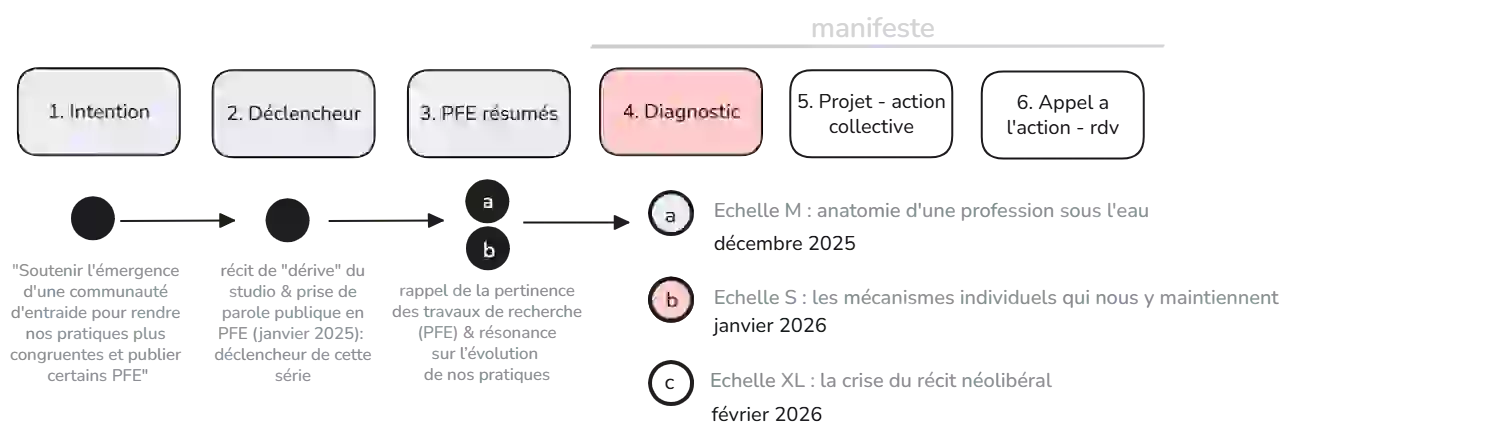
_Progression diagram & links to previous emails: _1 ,2 ,3a ,3b ,4a — and this current text:4.b
Many thanks to Thomas for his critical and demanding read! <3
Recap
As we saw previously[1], we navigate a profession that is structurally underwater (scale M). We’ll now look at how these structural problems lodge themselves individually inside us (scale S) — before widening later toward a diagnosis of the polycrisis and a pathway of social renewal for our profession (scale XL).
The summary of the previous section (scale M) showed that:
Our profession isn’t struggling “by chance”. It’s being suffocated by an unstable market and growing complexity, pushing us deeper and deeper underwater.
Trapped in a concrete-monopoly industry — locked in by norms and political orientations, well-oiled in its neocolonial market logic. In this context, change becomes complex, costly, risky — and therefore rare. And while our profession generates value that irrigates an entire sector of the economy (the construction industry), we absorb, in an unjust equation, the mental, legal, and relational burden — most often isolated, poorly represented, atomized — in precarious situations. We wear ourselves down in silence in service of a system that destroys the living world, each in our own corner. And meanwhile, everything is cracking.
What remains hardest: understanding why, despite all of this, we keep going.
What keeps us here — accepting, justifying, rationalizing — and how do we uncondition ourselves in order to learn to act together?
The system holds not only through constraint. It holds because it seduces us.
II. What are the individual mechanisms keeping us in this untenable situation?
Beyond symptoms: the roots of our paralysis — scale S — individual
The crisis in our profession stems from deep, intertwined mechanisms that produce ordinary states of constraint on individuals — making it hard to set sail toward new practices.
What are these individual mechanisms that keep us in unhealthy grips and relationships with our work?
We propose looking at these mechanisms through four categories (intimate, symbolic, social, work organization) — four ways a structural problem miniaturizes itself inside us:
- A (intimate/habits): What passes through attachment and through the body — and what the profession builds into us.
- B (symbolic/status/recognition): mechanisms sustained by social rewards (prestige, legitimacy) — that orient our choices without us having really decided.
- C (social conditioning): the layer of conditioning that makes everything else feel “normal” — it produces reflexes, thresholds of tolerance to ordinary injustice, and our ways of individualizing structural problems.
- D (economics and work organization): the material floor: cash flow, deadlines, inertia, sunk costs — the matter that factually locks in change.
I propose working through them deliberately in this order: first what it feels like (intimate), then what it rewards (symbolic), then the analytical layer of our social conditioning (what makes the rest ordinary), and finally the machine that locks everything in place (economics/organization).
Note: I want to stress that this text is open to critique, additions. It almost certainly misses many mechanisms — only those I’ve studied so far appear here. Let’s feed this reflection together, to name reality with authenticity and clarity — the first step toward reclaiming power over our situations. (See participation options at the end.)
A) Intimate mechanisms and professional habits
The mechanisms that work through attachment, the desire to do good work, fear, the body — what keeps us here even when reason says no. We also include “cognitive” effects of the profession (doubt, dispersal, paralysis): they’re experienced individually, but produced by professional conditions.
1) The good things that keep us here
Like any difficult relationship we stay in despite the suffering, there are good things that keep us in the profession. Everyone has their own personal reasons. Here’s mine:
I understood why I stayed the day I saw someone living in the first flat from my first project. More than two years into my independent practice, I finally felt in my body the usefulness of my work. A kind of deferred, subtle but present reward — a sort of “smile” from a renovated space, thought through down to the details, quietly telling the story in many spots of its adventurous unexpected twists. A result that showed where I’d fought in negotiations, the satisfaction where I knew the plan was well laid. Also silently asking forgiveness of the space for the places where I had let things go, remembering the cold sweats and hard conversations. And so much patience, so much persistence, holding the frame and finding resolutions. But in the end, it came out. Not perfect. But done. Phew!
I told myself that this job is so complicated I wouldn’t envy whoever had done it in my place. They’d have my respect. In that moment, I felt useful, in the right place. It was genuinely gratifying.
I love this profession that makes me live intensely: drawing, space, materials, people, the building site, the rare joy of a well-considered space — and this passion for the living world and the metabolic organisms of our buildings and cities.
But somewhere I also partly hate this job — mostly because of the conditions in which I practice it.
2) The precarious “passion profession”
Our role as project conductor carries major responsibilities: diffuse coordination, constant arbitration, micro-rescues, and a great deal of work “in the shadows,” off-book.
The problem isn’t just “the income.” It’s the whole package: instability, under-billing, mental load, legal risks, constant availability, loneliness in the face of conflicts — and, at the end, a body that absorbs it all. Precarity becomes a way of life.
In this context, the “passion profession” becomes a trap: we end up confusing vocation and sacrifice. Asking the right price, setting limits, refusing the unacceptable — it starts to feel like betrayal. So we give more: more time, more attention, more responsibility — without the system compensating for any of it.
A few figures give a sense of scale: (ACE 2024)[2]; in France, we invoice on average barely half our hours; and a significant proportion of the profession lives below very low income thresholds (Archigraphie 2024-2026) [3]. Add to that: precarity is a major factor in the deterioration of mental and physical health (DREES, 2020)[4].
Passion, fine. But self-respect comes first — and loving something doesn’t justify wearing yourself down for it.
What if we asked the real question: what do we actually love about this work — enough to stay — and what are we refusing to keep paying for?
3) The delegitimizing critical drive
The main tool of our profession is intellectual. It’s the critical gaze and methodology — enabling us to analyze, prioritize, compare, confront — in short, to establish what is true. An essential clarity tool for navigating the countless complex situations of daily practice. Precious in a chaotic era.
But the price can be steep: this sharpness installs permanent doubt, difficulty choosing and acting, and often a loss of legitimacy.
There’s a fairly well-documented cognitive trap here (the Dunning-Kruger effect): confidence is not correlated with competence. The less you know, the more you assert; the more you know, the more you see the blind spots — and the more you hesitate. This critical faculty creates a gap between knowledge and action: we see, we understand… and we often stay paralyzed.
In our profession, this translates very concretely: we are critical, clear-eyed, but resigned. Lacking confidence and organization, we minimize our capabilities, we don’t dare bill at the right price, we absorb the cost at the many crossroads of a project — at the expense of our health. We’re underwater, isolated, fragile — socialized to operate this way, without the psychological and social support, and without the frameworks that would allow this demanding critical drive to flourish.
In a system where we carry heavy responsibilities and live in our bodies the cost of complexity, doubt easily becomes a survival strategy: we retreat, we critique among ourselves, we wait until we’ve “fully understood” before speaking.
Yet that withdrawal carries a political cost: while we stay silent, others write the script — with economic and quantitative logic that isn’t enough to make society.
We don’t need to be perfect. We just need to be audible.
The real question may not be “am I legitimate to speak?” but: “what is keeping me from speaking, even imperfectly?“
4) The scattered generalist
If the critical spirit is so central to our profession, it’s because architecture is a profession of assembly: you need to understand a bit of everything, put things in order, prioritize, arbitrate.
Learning is permanent — and doubt comes with it.
This versatility of our skills is essential for adaptation, but it has a downside: in a world organized by specialists (often in silos), our transversal work doesn’t read well. We see broadly, hold several variables and scales at once — so it takes longer to converge: to decide, to formulate a short synthesis, to make our arbitrations legible. And when we want to be precise, it takes time. The result: our voice circulates little, and our skills often remain implicit in the public debate, as noted by the National Assembly report (2014) [5].
The trap, then, is comparing ourselves to specialists on their own turf. They optimize one variable; we arbitrate several. Our value isn’t to be experts in everything, but to make complexity livable and understandable: to bridge, to extract the essential, to align expertises that don’t talk to each other.
Our difference — this thinking capable of making connections — is precious for reconfiguring a fragmented, specialized, siloed world that is so inefficient. But how do we exercise it without exhausting ourselves? How do we convert a broad vision into clear decisions — without sacrificing nuance?
B) The mechanisms of social recognition
These are the mechanisms sustained by social rewards (prestige, legitimacy) — that orient our choices without us having really decided.
1) Archistar: the profession’s dominant model?
As social beings, we need models. Not only for inspiration: to know what “legitimate success” looks like. To reduce uncertainty, give our identities something to hold onto, feel like we belong. The problem is that these symbolic compasses are also loaded with embedded norms: they shape our desires, our gestures, our language — and render other ways of existing in the profession invisible.
In architecture, the most valued model remains that of individual signature and distinction: the archistar (or its variants). This culture feeds isolation and competition between colleagues, in the name of “creativity,” even as an aesthetic homogeneity runs through dominant production. (Molina, 2015) [6]
This cult of models is a practical machine for social reproduction: in the name of “success,” exploitation becomes desirable (all-nighters, precarity, silence), hierarchy gets naturalized (a minority that shines, a mass that is exploited), and solidarity is broken — exactly where it would be vital.
So the question isn’t just: “who do we admire?”
It’s: do the figures we’ve been exposed to (in schools, in firms, in the media) depict a way of life that’s actually desirable long-term, compatible with our bodies, our relationships, our life projects?
And conversely: what alternative, desirable models already exist — what practices are socially useful, sustainable, capable of building common ground without burning people out? Let’s choose new models — or invent them!
Because aesthetic recognition alone remains fragile when the profession suffocates individuals. And as long as we remain prisoners of these codes, we’ll keep calling “creativity” what all too often looks like organized conditioning.
2) The permanent search for social utility
The practice of architecture — an art of assembly, at the intersection of disciplines — is in permanent recomposition through the ages, adapting to what it connects. We might navigate architectural history to deduce, epoch by epoch, the relationship of the architect to power, (as JL Cohen does skillfully in his Collège de France course [7]).
We can also affirm that our profession isn’t just a service: it’s a social function. A vocation of general interest, since what we build establishes social relationships — which requires permanently questioning our role, our contribution to the common, different at each era and each context. If we are historically most often in service of dominant power, there are many counter-examples of disruptive, generative proposals from architects. (Belabed & Tura, 2023) [8]
So, if our discipline has both the capacity to perpetuate hegemonic value systems and to propose new orders — in service of what do we want to work?
- Supporting the powerful who exploit the weak, homogenize cultures, destroy our environments?
- Or supporting the emancipation of individuals and communities to live intelligently with their surroundings?
What is perhaps most vertiginous is not nurturing this critical questioning ALONE — it’s not doing it at all.
The “search for social utility” can be real in its facts (and its real effects on lives), but it can also become a consoling narrative — a way of feeling like you’re on the right side, a kind of “meaning”-washing, while you lack grip on the rules of the game and continue a logic of exploitation of the living and of individuals despite your good intentions. A way of compensating political impotence with moral virtue.
3) The sirens of power and recognition
The permanent search for social utility carries a paradox: the weight of collective responsibility confronted with our individual values. For we are, as a professional body, historical intermediaries of power — caught between hammer and anvil — guardians of a technical, administrative, and legal complexity that we must defend, under threat of consequences that can sometimes go as far as imprisonment.
Nevertheless, for the vast majority of us, this shared responsibility and ethics leave little room for the individual: their values, convictions, choices. In a contracting construction market, it becomes almost impossible to choose which power you serve, inside an all-powerful capitalist system, with thin margins. It’s a fair bet that by default — often despite ourselves — we play into the hands of the dominant. As La Boétie saw long ago: “The tyrant tyrannizes through a cascade of little tyrants, themselves tyrannized but tyrannizing in turn.”
So we — the intermediary little tyrants — do hold power.
And if we exercise a power (that of the expert-prescriber, a social authority), let’s remember that it’s only a borrowed power — and therefore one that obligates.
Obligates to protect (the public, users, the quality of use when technique wants to flatten everything), to open (the doors of a network, a jury, a commission to those who never access them), to redistribute (time, visibility, margins, knowledge — sometimes simply a voice), and to refuse the small ordinary cowardices (undercutting “just to get the project,” silence in meetings, compromise dressed up as pragmatism).
Everyone does their best, of course — and idealism can be its own form of tyranny. Yet what I want to say is delicate: if we don’t ask ourselves what social purpose what we build actually serves, we put our intelligence in service of an aestheticizing spatiality with no common purpose. In that case, we become — despite ourselves — auxiliaries of the systemic oppression of a system that crushes the living, constrains the “lower” classes, and mortgages our future.
Power becomes dangerous when it becomes reflex, when it’s “neutral,” technical, and “apolitical”: we exercise it without looking at what it produces socially. While paradoxically believing we’re powerless to contribute — or even to be a force for proposal — for the common good.
What we call “symbolic” (prestige, signature, recognition) is a machine for social sorting. The codes of the “good project,” the way of speaking, writing, holding oneself in a jury, of naming the world — none of that is neutral. It rewards certain socializations, and penalizes others.
In other words: the symbolic is a mechanism of class and social conditioning that doesn’t say its name. And that’s why what follows isn’t “just another chapter,” but the layer that makes everything mentioned here feel… ordinary, banal, and invisible.
C) Our social conditioning
The layer of class social conditioning that makes everything else feel “normal” — it produces reflexes, thresholds of tolerance to ordinary injustice, and our ways of individualizing structural problems.
1) Advantages and privileges
We have to hold two true things at once.
On one side, a very concrete material precarity: unstable income, race-to-the-bottom competition, disproportionate responsibilities, chronic fatigue. On the other, even when we’re struggling financially, we may carry less visible privileges: level of education, mastery of institutional codes, networks, cultural capital — all that makes certain doors easier to push, and certain narratives more “audible” than others. (Rose Lamy, 2025) [9]
You can be economically fragile and socially privileged on other axes — and vice versa. The “privilege wheel” helps you see this without lying to yourself: it forces you to look at the intersection of axes (class, gender, race, health, disability, nationality, cultural capital…) rather than reducing social position to one variable.
And above all: it’s not there to judge us — it’s there to help us understand how we’ve been conditioned.
Because a privilege isn’t just a “bonus”: it’s also a socialization. It opens access, but it also teaches what’s “presentable,” “reasonable,” “professional.” It produces reflexes: what we dare to say, what we allow ourselves to ask for, what we’d rather keep quiet to stay within the codes.
In our profession, the central privilege is cultural capital: the taste, the references, the way of speaking, of presenting a project, of being in a jury. An invisible passport that doesn’t read as privilege — but quite necessary to belong to the milieu.
2) The central trap: internalizing the problems
When you come from a world where you’ve been taught to “succeed,” you’re also taught to hold yourself responsible for everything: if I’m suffering, it’s because I haven’t worked enough, haven’t optimized enough, haven’t “managed” well enough. Suffering becomes an individual defect to be corrected through more discipline, more performance, more personal development. (Teste, 2023) [10]
Decolonial (and Afrofeminist) critiques of self-care don’t just say: “individual strategies aren’t enough.” They point to a more violent displacement: a care tactic born in struggles that was captured, whitened, commodified — then returned to individuals as an obligation to “manage well” what structures are breaking. Instead of opening collective power, it can close suffering back into the private sphere. Hence the shift toward community care: less “repairing yourself alone,” more care and mutual aid infrastructures. (Meleo-Spurgas, 2023) [11]
The trap is that suffering already makes you lonely — and therefore increases the temptation to conform so as not to become more isolated still. And isolation is politically useful to the system: everyone tends to their wounds in their corner, everyone “manages,” nobody mutualizes, nobody transforms the rules. Power needs sad bodies to dominate, said Deleuze.
Isolation is not an accident — it’s a cultural and social structure.
3) School conditioning: competition and learned isolation
Our schools (and not only the architecture schools) are traversed by a selection logic that rewards conformity: producing in the right format, at the right rhythm, in the right language, under pressure.
Albert Jacquard put it bluntly: if “being the best” becomes the engine, you mostly select the most conformist — those who know how to dedicate their intelligence to what’s expected of them, even if it damages them or doesn’t serve society.
Competition, coupled with the all-nighter culture, is sold as the engine of excellence. But it also produces a reflex: seeing the other as an obstacle, cooperation as weakness, the collective as a luxury. And when this reflex extends into the profession (through starchitect models, the cult of distinction, competition), it combines perfectly with our material insecurities: we exhaust ourselves, but we keep going, because we no longer quite know how to exist outside these codes.
4) Deconstruction: not a moral luxury — a condition of exit
We didn’t choose our conditioning; but we can choose what we do with it. And “deconstructing” doesn’t mean giving yourself a slightly cleaner facade with good intentions: it means going to see the structure working underneath — these embedded reflexes (competition, over-adaptation, need for validation, fear of losing ground, lack of legitimacy) — all the things that make us docile, isolated, and ultimately harmless… even when we’re right.
The work goes well beyond “the profession”: family, class, trauma, relationship to conflict, to money, identity, gender, care, cooperation… it all holds together — everything is interrelated. As long as we don’t touch the deep roots, we replay the same scene in new settings, endlessly. Tenderness, here, isn’t minimizing reality: it’s making a lucid diagnosis, saying what is without condemning.
And “acting together” isn’t a warm-sounding formula: it’s a structural question. Because the way out isn’t alone: nobody crosses this shift through individual improvement. It happens through a common culture, and micro-infrastructures — frameworks, supports, solidarities, spaces, rhythms — that make the bifurcation breathable, shareable, transmissible. And simply, possible.
It happens with bonds capable of holding what is real, conflict, vulnerability — and with enough concreteness that our ideas stop being intentions and become ground.
Deconstruction is not a moral: it’s a process of renewal, and of individual and collective transformation.
D) Economic locks and work organization
The material floor: cash flow, deadlines, inertia, sunk costs — the matter that factually locks in change.
1) Ordinary alienation
Despite our critical clarity and all our competencies, our bodies undergo a more subterranean constraint: the alienation of labor. Whether salaried or independent, we have to sell our time to pay the rent, keep cash flow afloat, support those close to us. Our life commitments bind us to our professions more surely than our love for them.
Marx is useful here because he names a banal mechanism of submission.
When your survival depends on selling your time, you can “choose,” but only in a narrow corridor. And that corridor produces a practical docility: we accept what we know is bad, because the immediate alternative is the void — and more precarity.
In our professions, alienation takes a very concrete form: the fact that we carry responsibilities but control neither the demand (clients, market), have little grip on rhythms and deadlines, and have no means of capturing the value that the project actually generates. We’re not just “tired.” We’re caught by a system. This is not a lack of willpower. It’s a material dependency that binds us.
2) Value capture
The liberal profession lives a paradox: officially autonomous; in reality, dependent on an unstable flow of money, late payments, unbilled hours, legal risks. We learn quickly to “absorb”: absorb the mental load, the unexpected, the tensions, the micro-negotiations, the emails, the follow-ups, the pedagogy — absorb others’ mistakes — because if you don’t, the project falls apart.
And while we absorb, value flows. It irrigates construction companies, banks, platforms, insurers, developers, energy vendors, engineering firms… and while we hold the interface — often with a fragile margin — we carry the risk. While others capture the rent.
3) Bifurcating, or the sunk costs
There’s another chain, more discreet: time. Projects last months, sometimes years. We grow attached, emotionally indebted, building a reputation, a clientele, a local trust. Breaking free sometimes means throwing away years of prospecting, accumulated expertise, investment, work — and that can hurt even more than staying in conditions that are pushing you to break point.
This is what economics calls “sunk costs.” And what the body calls “I’ve already given too much to let go now.”
Do we bifurcate because we break?
Conclusion
What keeps us underwater is not an individual defect. It’s a tight, structural knot — one that manifests in individuals.
We stay because we love: spaces, people, materials, the rare joy of a well-considered place.
We stay because we hope: for recognition, legitimacy, social utility.
We stay because we’ve been formed: to hold on, to perform, to compete, and to stay quiet.
We stay because we depend: on cash flow, reputation, sunk costs, subsistence to ensure.
So the question isn’t “should I stay or leave and bifurcate?”
The question is: where do we start loosening this knot — and I’d add: together?
Not through individual heroism.
Through community infrastructures.
Not through mandates. But through mutual support.
Not through perfectionist purity. But through small, successive anchoring points — which it’s worth celebrating, however small.
And then there’s the paradox that drives me to write all of this: we already produced, during our studies, some of our most audacious work — and yet we let our contributions to the public debate die in our archives. Along with them, perhaps, the hope of changing our condition.
Our graduate theses, our research, our work, our narratives — even imperfect — are often prototypes of exits: attempts and proposals for rearranging the real. And these demanding studies, conducted with resources, time, quality accompaniment, relative freedom, and commitment, have a quality we no longer have — or so rarely — in professional life.
While they could be compasses: not absolute answers, but handholds. Points of support for clarifying our trajectories, recovering coherence, building alliances, and reopening what’s possible.
Let’s weave these possibilities together. There’s so much to gain!
What’s next: an analysis across the current social situation (scale XL), to then propose ways of regaining grip on it; to renew the social role for our profession.
What if there were better things to do with our skills?
What if, in these conditions, there were so few reasons to keep holding on in ways that wear us down?
Maybe architecture, at its core, is not only about producing objects: it’s a discipline of transversality. A capacity to untangle complexity, rearrange scattered elements, make livable futures.
If that’s true, then our crisis isn’t only professional: it’s political. And our exit won’t be individual.
Let’s put forward a hypothesis — that we are, at heart, practitioners of rearrangement: that our skills include the capacity to help diagnose, connect, and reconfigure ailing social infrastructures.
Invitation to contribute to this text
Did this text move you — for better or worse? React! It belongs to you. It belongs to all of us. So that our voices carry, and are heard. So that these ordinary collective oppressions stop crushing individuals in the silence of solitude. Let’s speak up, collectively. Let’s act. With the conviction that there’s no other help to expect than our own, and that of our peers. That we have the right to aspire to much better — for ourselves and for others.
- Video call: I’m proposing a 1h30 meeting on Tuesday February 3rd at 7pm. Google Calendar link & video call link. Facilitated by me, in a friendly and safe atmosphere where your testimonies, resonances, reflections, and critiques are more than welcome. I commit to holding the time and offering the space!
- In writing: you can add comments, contribute, nuance, or critique directly in the text. Or reply to this email more quickly.
- By voice message: react with a voice note on this Telegram chatbot which will transcribe your words. It doesn’t use AI, runs locally on my server, and is low-energy. You’ll need to download the app — a good excuse to leave WhatsApp-Facebook? ;)
See you in a month for the next piece!
(I’ll send a small reminder email for the video call on Sunday February 1st)
Thank you so much for reading this carefully — it means a lot <3
Note: six of us did a close reading of the previous text, scale M (09/12/2025). Thank you!! Here are the written notes and the audio summary .
Backstage:
I want to share the backstage of this work, because I believe transparency and vulnerability are the foundations of authentic connection — and with a view to collaboration at some point * wink wink * ;)
In this section I go a bit against academic writing, and it may seem a bit too much? haha
Phew — writing this text was a bit complicated. I’m glad it came out! The reasons:
Timing-wise; the end-of-year holidays, the return to work, a lot of projects — it wasn’t easy to carve out quality time to see this through, and as a result I find it a bit immature.
Intellectually: I couldn’t push this research with the rigor I think the subject demands, or get it read as much as I’d have liked (time constraints). The result is that it’s long without being particularly impactful or clear. The density and interest of different sections is fairly uneven, I think. I found myself drifting off at points when re-reading.
Emotionally: this is a text written from a single point of view — though nourished by many conversations, debates within OFQA over nearly three years, extensive reading and introspection. But I question the relevance and legitimacy of one individual speaking to the diversity of our individual experiences. I aspire to write with multiple hands, to have this text deconstructed, re-questioned, reconfigured — reclaimed by others.
If I go all the way with this laying-bare, I have to confess, not without some embarrassment, that specifically for this text — which made me doubt a lot — my best ally was an artificial intelligence. It was a partner in critical reflection, discussion, proofreading, and assistance in reformulating complex ideas in certain passages. You can see its fingerprints in some of the phrasings I still find a bit complicated, with quite a few redundancies in the text.
It’s not perfect. But to be coherent with what I’m saying — that it’s a challenge for me to accept lowering my standards, and that it’s better to be imperfect and audible than a perfectionist staying silent — especially since I still have a lot of text to send! I’m improving as I go, I tell myself :)
Thank you for being here <3
With great joy at reading your responses and exchanging during the reading circle.
References
[1]: Nény, Jules. « Anatomie d’une profession sous l’eau ». trans-former.fr, 30 nov. 2025. Article : https://www.trans-former.fr/aep-em3-p1/
[2]: Architects’ Council of Europe (ACE) ; Mirza & Nacey Research Ltd. The Architectural Profession in Europe — 2024 Sector Study. ACE, avril 2025. PDF (EN) : https://www.ace-cae.eu/wp-content/uploads/2025/04/2024-ACE-Sector-Study-EN-04042025.pdf
[3]: Conseil national de l’Ordre des architectes (CNOA). Archigraphie 2024-2026 (observatoire démographique et économique de la profession). Ressource : https://www.architectes.org/publications/archigraphie-2016-1834
[4]: Leroux, Isabelle ; Morin, Thomas. « Facteurs de risque des épisodes dépressifs en population générale ». Études et Résultats , n°545, DREES, 1er décembre 2006. PDF : https://drees.solidarites-sante.gouv.fr/sites/default/files/2020-10/er545.pdf
[5]: Assemblée nationale (France). Rapport d’information sur la création architecturale (n°2070, déposé le 2 juillet 2014), prés.-rapporteur : Patrick Bloche. Notice : https://www.assemblee-nationale.fr/14/rap-info/i2070.asp
[6]: Molina, Géraldine. « Distinction et conformisme des architectes-urbanistes du “star system” ». Métropolitiques , 18 juin 2014. Article : https://metropolitiques.eu/Distinction-et-conformisme-des-architectes-urbanistes-du-star-system.html
[7]: Cohen, Jean-Louis. « Architecture des pouvoirs et pouvoir des architectes » (cours : L’architecture, vecteur du politique). Collège de France (année 2017–2018). Page : https://www.college-de-france.fr/fr/agenda/cours/architecture-vecteur-du-politique/architecture-des-pouvoirs-et-pouvoir-des-architectes
[8]: Belabed, Lisa ; Young Tura, Auden. « Les architectes lancent un appel… ». CCA (Canadian Centre for Architecture). Article : https://www.cca.qc.ca/fr/articles/99307/les-architectes-lancent-un-appel
[9]: Lamy, Rose. Ascendant beauf. Éditions du Seuil, 25 avril 2025. Page éditeur : https://www.seuil.com/ouvrage/ascendant-beauf-rose-lamy/9782021596069
[10]: Courbet, Soazic (réal.). « Politiser le bien-être — Rencontre avec Camille Teste ». L’AFFRANCHIE PODCAST , épisode S3E40, 27 juillet 2023. Apple Podcasts : https://podcasts.apple.com/gb/podcast/politiser-le-bien-%C3%AAtre-rencontre-avec-camille-teste/id1539909449?i=1000622467861
[11]: Spurgas, Alyson K. ; Meleo-Erwin, Zoë. Decolonize Self-Care. OR Books, 2023. Page éditeur : https://orbooks.com/catalog/decolonize-self-care/