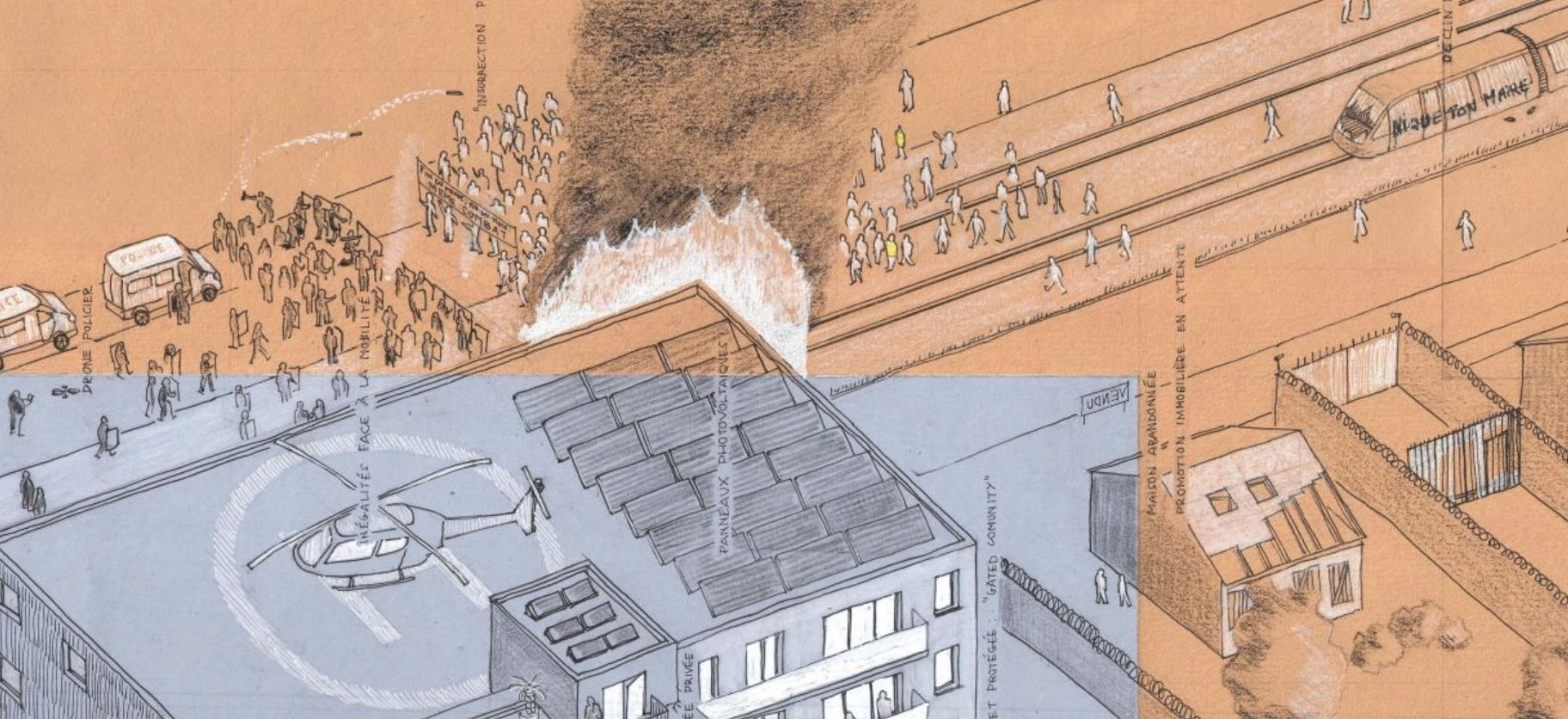
Anatomy of a society in crisis
The global polycrisis & the social purpose of our profession — scale: XL
If we want to reconnect — or reinvent — the social role of our profession, we first need to understand something about where society actually stands. Not just within the profession, but in the society that produces it — and that we serve, whether we like it or not.
In previous episodes, we zoomed in on our profession “underwater” (M scale), then on the more intimate mechanisms keeping us there (S scale). Here, I zoom out. Because our professional crisis is only a symptom — and because if we don’t understand the terrain, we won’t know what (or what) to push against.
Previously in the series The profession is structurally built to keep people under pressure (uncertainty, complexity, responsibility, deadlines, budgets) (M scale). This isn’t an individual failing — it’s a structure. We stay because there are rewards: sometimes a meaningful project, a moment of beauty, some recognition, the sense of being useful — and the vocation itself. The problem is that the situation is unsustainable, and it wears us down. The absence of exit routes and solidarity keeps us stuck; overload, precarity, and loneliness become normal; and eventually we come to believe that if things are going badly, it’s because we ourselves are not enough.
The text proposes shifting our response: lucidly owning the (borrowed) power of the prescriber, refusing solitary heroism by changing our models, and rebuilding shared support. Hence the call for forms of mutual aid and collective resource-sharing (book clubs, publications, archives of final-year projects) to regain agency and reopen paths forward.
III. The crisis of narratives
From a global perspective, our profession’s crisis is just an epiphenomenon — a ripple from a deeper tremor: a crisis of Western culture, of our collective operating system for making sense of the world. Today that system — liberal, capitalist, individualist — is cracking everywhere, threatening the survival of living systems and our own milieux.
Our “collective operating system for making sense of the world” is the sum of a shared culture, woven from countless elements and narratives, converging into a system of ideas and values that gives meaning to the world, orients action, and justifies a “natural” social order: a collective narrative, an ideology, a paradigm. Homo fabulator — our species makes narrative its shared cultural foundation — money, nations, religions, history… (Molino, 20031)
Analysing this crisis of the dominant (neoliberal) narrative helps us understand more clearly where and how we can reconnect with our social utility — as acupuncturists and prospective narrators in service of the evolution of that narrative, and of our social structures.
The situation: polycrisis We are in a moment where history sends chilling signals of a polycrisis: seven of the nine planetary boundaries crossed, collapse of biodiversity, abyssal and growing inequalities, rising wars and geopolitical tensions, fascist surges across the globe — and a return of the weak signals that preceded the last World War: scapegoating, security crackdowns, more or less overt censorship, information control, attacks on checks and balances, expulsions and segregation, and social inertia in the face of a “normalised” horror. (V-Dem, 2025; Freedom House, 2024)2
Well documented by collapsology (Servigne, 2018)3, which shows the fragility of a globalised, interdependent system made vulnerable by the dwindling of its main resource — black gold (Auzanneau, 2015)4 — it seems inevitable that our unstable system runs toward crises and collapse.
Faced with this instability, the most reassuring ideology — or at least the most popular — appears to be the preservation of the established order. Or even its rollback to an earlier one. This authoritarian impulse, driven by the perception of insecurity and instability threatening the social order, justifies expanding the state’s security apparatus to contain the effects of these changes — social tensions — without addressing their causes.
If this strategy seems the opposite of the flexibility and experimentation that a civilisational shift demands, it persists perhaps because there are so few coherent, systemic, actionable counter-narratives to oppose what looks increasingly like yet another monopoly: the monopoly on writing our collective story.
The cracks in the hegemonic narrative
The dominant ideology: “infinite growth in a world of finite resources” — firmly locked in The core of the neoliberal doxa rests on a paradoxical injunction: infinite growth in a world of finite resources. This translates into “perpetual optimisation of performance for the purpose of wealth accumulation by a minority.” Enrichment at whatever social, political, and environmental cost leads us toward the exhaustion of our resources, and the extinction of our species. This ideology, well entrenched in its institutions (schools, norms, culture, markets, media), maintains and reproduces the established order. (Rousseau, 1762)5 already identified that a social regime (and its institutions) produces types of human beings — not merely opinions.
The matrix of the dominant ideology: imperialism Historically, the origin of our current narrative (capitalist, neoliberal) is rooted in an older ideology: imperialism.
The promise of imperial ideology is peace and prosperity in the name of progress. The price is security — in other words, “the ordering and control of populations, presented as their protection” (Foucault, 2004)6. It is undeniable that over the past two millennia, humanity has developed more than ever before — demographically, economically, civilisationally — but this has always come through the imposition of the powerful on the weak. Roman Empire, Church, monarchies, bourgeoisie, Napoleon, Mao, Stalin: power and wealth are concentrated by a minority, exponentially growing in strength.
A dynamic that, to this day, changes clothes without changing its nature: the concentration of power. Today, (Oxfam, 2024)7 reminds us that the wealthiest 1% own more wealth than the bottom 95%. If I may draw the historical parallel: the Ancien Régime also rested on a dominant layer — clergy and nobility made up roughly 1–2% of the population, but structured access to land, status, power, and rent for the remaining 98% (Piketty, 2019)8.
This is what Marx made impossible to unsee: the class question as a structure, a geometry that persists — a minority capturing the surplus, organising others’ dependency, then fabricating the narrative that makes this domination “natural” (merit, order, civilisation, security, progress).
In short: one social class crushing the others — or, put differently, the appropriation of power by an elite, whatever the era, whatever the costume.
And where does architecture fit in? It is not “outside” this. Architecture materialises dominant narratives: it makes an order visible, liveable, durable. And its social role has varied with regimes — without ever ceasing to be a lever of governance (Cohen, 2018)9.
- Ancien Régime: the architect as the sovereign’s learned arm (representing, ordering, monumentalising: palaces, squares, axes, cathedrals, fortifications).
- Revolution / industrial bourgeoisie: architecture becomes a tool of industrialisation and discipline (factories, barracks, hospitals, schools), and of land value creation (boulevards, “improvements”, speculation).
- 20th century: the welfare state and its grand narratives (social housing, public facilities) coexist with functional planning (zoning, infrastructure) — then the city-as-enterprise.
- Today: competition between territories, “platform urbanism”, production of real-estate value, and decision-making captured by finance / developers / regulations.
There have been bifurcations (and they matter): moments when the architect positioned themselves in service of the commons — cooperatives, self-management, municipalism, housing movements, situated practices. But the core of the problem remains: in a class society, the built form distributes power (access, separation, visibility, rent). Reinventing our social role thus means choosing which power we make possible — and for whom.
In sum, imperialism is not simply a model of political power (centralised, vertical, elite-driven) — it is above all an ideology of domination that seeps all the way into the intimate, conditioning and colonising our worldview. Good over evil, mind over body, ideas over emotions, father over family, man over woman, human over nature, employer over employees, president over nation, North over South, white over others, and so on.
Empire as operating system is a monoculture of ideas, guided by an antisocial rational mind, slowly suffocating populations and our living environments under its yoke for the benefit of an oligarchic, oppressive minority.
Yet this thousand-year-old software has been regularly “updated” and evolved over the ages.
The long war of narratives These “narratives” — or cultural paradigms — that govern our collective relationship to the world, fluctuate, crack, break, and mutate over time, enabling collective shifts in how we understand the world. I propose reading them through three parameters, to better understand their secular dynamics and illuminate our current political and social situation, as unstable as history always has been:
-
The first, already partly explained above, is the domination of one narrative over others — history written by the victors seeks to silence that of the vanquished. “Heretics,” dissidents, revolutionaries, utopians, resisters, scapegoats, indigenous peoples, marginals, anarchist free-thinkers — all those who contest the frame, because they are outside it, are fought. Imperialism uses force to impose itself. It fears the diversity of worldviews that might challenge its monopoly, the freedom of individuals and of thought. It seeks to erase local identities and cultures in order to standardise and homogenise them, facilitating their exploitation in service of the commercial flows of globalisation (Krenak, 2019). The important exegetical and revolutionary work of Pacôme Thiellement (2023)10 restitches the margins of the history of the defeated in order to reclaim the fabric of our common, popular, oppressed, libertarian history. Changing the story we tell about the past changes the perspective we hold on the future. There have always been free spirits who lived in contestation of the doxa, whom posterity has never stopped admiring… perhaps the better to keep them at a distance?11
-
The second is the alternation of cultural paradigms, or worldviews. Though open to critique, the work of Harari in Sapiens (2011)12 illuminates the civilisational dynamic of alternation between conservative and more progressive phases. Each phase integrates a new relationship to the world, which he calls a “cultural paradigm”. For example: after the Middle Ages (conservative), we move to the Renaissance (progressive humanism), followed by the Baroque (conservative neoclassicism), then the Enlightenment (progressive again), the monarchy (conservative), then the Revolution (progressive), the Terror and Restoration (conservative), democracies (progressive), fascism (conservative), and so on… He reminds us that civilisation advances in opposing “bursts,” and that what seems inevitable never remains so forever.
-
The third is acceleration (Rosa, 201013)14: our society has tended from its origins to accelerate exponentially. Today, this technical and social runaway is so rapid that it desynchronises our experience of the world from our capacity to process it; it pushes individuals, social groups, and democracies into crisis. It alienates, while simultaneously making transformation both urgent and harder to inhabit. This acceleration of extremes (climate, wealth…) generates a pre-insurrectional, unstable climate (as noted by several reference institutions: US/UK/DE armies, UN, OECD): our century is a civilisational turning point (Hamant, 202315).
Understanding the struggle of our histories and narratives oscillating between opposing paradigms, in an increasingly unstable acceleration. Hard to conceptualise, but what seems taken for granted in our current paradigm will not be tomorrow — and history shows that a direction calls its opposite.
If we read the current situation through this lens: the Fifth Republic, an imperial social structure?
If we zoom out to the historical dynamic and then come back to today, we realise that this vertical imperial operating system did not dissolve “by magic” with democracy — it reconfigures itself.
Historically, democracy is a “young,” unstable social organisation, living from crisis to crisis. “The worst system, except for all the others” (Churchill, 1947).
The vertical power structure persists today in our democracy: the Fifth Republic, a power-organisation project carried by a general, resulted in a regime centred around an individual. While the intention was defensible — giving the means to act quickly and effectively against a Fourth Republic paralysed by parliamentary deadlock — one of its presuppositions is extremely naive, even problematic: assuming that concentrating power benefits everyone and that providential individuals rise to presidential power. Whereas this hyper-presidentialisation produces authoritarian decision-making, weakens checks and balances, and ultimately shrinks the commons (Rosanvallon, 2016).
Our forebears died to drive out imperialism in the Revolution and to resist fascism in the Second World War, yet its dynamic returns through the window, normalised by our colonised imaginaries.
Democracy, or the inertia of critical change Though inherited from ancient Greece two thousand years ago, democracy has only been practised — with interruptions — for about two centuries (since 1789), which is relatively “young” from a historical perspective, perhaps partly explaining its chronic instability.
Yet while democracy evolves — notably through the welfare state it founds, significantly improving conditions for the majority — one element persists: its ancient vertical power structure inherited from imperialist logic. The bourgeois caste replaced the aristocracy in 1789.
We observe today that there is a functional oligarchy, a minority elite with strong capacity for framing and leverage (economic, media, regulatory, protective), orienting priorities and setting the parameters of debate. Slowing or accelerating reforms according to its interests, through intermediaries and lobbies.
Take the recent “Zucman tax” as an example: it was not rejected by a neutral Senate, but by the convergence of four levers — executive, upper chamber, employers’ lobbying, and media framing — which converted a minimum tax on 0.01% of fortunes (ensuring their annual taxes reach 2% of their asset value) into a “threat to the economy,” before burying and then defanging it into an inoffensive version (Le Monde, February 202516)
It is becoming increasingly clear (for anyone who hadn’t seen it yet) that the business world and the political world both come from the same bourgeois social class, locking access to the summit of “democratic” power (Branco, 2019)17, and that capitalism tips into its authoritarian form when democratic mechanisms become an obstacle to the profitability of the dominant classes (Guérin, 1936)18.
Institutions lock the hegemonic narrative firmly in place.
The lock-in of our shared narrative channels
If the battle is a war of narratives, a culture war, then the question becomes: where do these confrontations play out? The answer is broader than “the media.” It encompasses all the channels that forge our imaginaries: education, schools, advertising, platforms, cinema, music, TV series, video games, mass culture, entertainment industries, and even everyday urbanism — the material infrastructure of what we find “normal.” The media is one piece of the system: important, but not alone. It is above all a node where capital, emotion, speed, and the political agenda intersect — the most visible tip of the iceberg.
Let us analyse this fragment — the media — as a revealing instance of the fascist-leaning privatisation dynamic running through our dominant culture.
The media is in principle the “fourth estate,” supposed to watch over the other three (executive, legislative, judicial) and expose abuses of power, guaranteeing citizens their freedom of information and thought. But it has been transformed by two shocks: the privatisation of media and social networks, distancing quality, verified journalism from public debate. Polarising opinions in a fascist-leaning dynamic that keeps accelerating the lock-in of counter-narrative channels — channels needed to propose other uses and stories beyond the neoliberal doxa.
Media privatisation: who tells the story, and on whose behalf? Today, in France, ten oligarchs own 95% of private media (Acrimed/Diplo 2025)14, representing 56.5% of TV audience share (32% for public media, 11.5% various). The public media’s share has been shrinking steadily for decades.
This concentration privatises not just truth, but above all its framing: little room here for experimentation, evidence-based debate, or verified information useful to public discourse — instead, opinion channels offering polemic coverage, rolling emotion, an opinion dramaturgy, breaking news without context or memory. Bolloré has admitted as much: “I use my media to wage my civilisational [far-right] battle.” (Beaufils, 2022)19. This ideological framing operates on audiences now significant enough to structure the agenda of social debates.
This media treatment aims to feed the spectre of an “internal threat”20 — even as crime rates have not risen since 198021 — while the sense of insecurity has exploded — in order to allow right-wing and far-right politicians to present themselves as saviours against an imaginary peril they themselves have stoked, ad nauseam (De Bure, 2024).
On the public discourse side, power confiscates speech by breaking free from reality and facts — through lies, accusatory reversals, broken promises — behind a formal facade that masks the suppression of deliberative thinking, paralyses parliamentary institutions and, by extension, governance, accelerating crises (Logocratie22, Viktorovitch, 202523).
Social networks: democracy of emotions or ideological confrontation? To escape these anxiety-inducing (dis)information flows, social networks propose a shift in informational paradigm — at once liberating and enslaving. Liberating in that they decentralise the information monopoly, allowing anyone to become a source of information in a digital public space. The price is drowning the signal in an infinite noise. All types of messages with different hierarchies (news, commentary, belief, hypothesis, emotion) blend together across different conversational contexts and registers of language, sowing confusion — one factor in information fatigue (info-obesity).
These tools are also enslaving: to capture our commodified attention, they exploit our thirst for emotions, sensations, and quick dopamine — in short, our hunger for human connection. Meanwhile, using our personal data, the algorithm targets our cognitive biases, feeding us the arguments our brains crave to counter the facts that unsettle our certainties, so that our “beliefs aren’t challenged” (Festinger, 1957).
So the absence of information feeds distrust of any interlocutor who doesn’t share our opinion and belief (Patino, 2023).
We are witnessing an emotional democracy (emotocracy), post-truth, the terrain of ideological confrontations tending toward ungovernability. We will see in the next section that social networks do offer a direct means of subverting the locked channels of traditional media.
The digital revolution is only at its dawn.
The drift toward authoritarian tech If social networks have become indispensable intermediaries for our social species — (averaging 1h48/day/person on social networks)24 — more than decentralising, they primarily concentrate the power of the most powerful companies on the planet (GAFAM), which have already acquired a private monopoly over digital public space. A problematic monopoly, in a world of growing disparities, where technological superpowers, the “new legislators” of Silicon Valley, become indispensable in the domains of security and digital infrastructure, conditioning our democracies by becoming their backbone (Morozov, 202525). The boundary between state and private interests blurs through unequal markets, deepening our dependence on these giants and mortgaging our sovereignty further (Bria, 202526).
In the absence of global governance over technological evolution, exponentially advancing AI is becoming an autonomous actor, rendering entire swaths of our economy obsolete. A rerun of transhumanism at a far greater scale. Though open to critique, a petition calling for a moratorium on super-intelligence27 — self-evolving AI on the verge of transforming the world — should not obscure the already-present securitarian and military acceleration with “basic” AI (identifying migrants for deportation, autonomous drones, automated mass surveillance, exploitation of annotation workers, military use in Gaza, social control, biased allocation of aid… (Synth 202528))
The dystopia is already here In sum, the channels of our shared narratives are locked down by an ideology, by the interests of an all-powerful caste, and by its revolutionary technological industry. A kind of silent coup of our institutions and welfare state by the private interests of an oligarchy over the commons.
And what if the growing concentration of power and information by a minority aimed to contain the instability of a social organisation with abyssal wealth gaps, where the welfare state — guaranteeing social peace through comfort — retracts in the name of neoliberal profitability? The channels of our narratives are being locked down to extinguish any impulse toward change or shift. Note that while it is easy for the powerful to lock down the channels of our narratives, it is far harder to lock down the narratives themselves — to prevent thinking, creating, imagining.
In this post-truth context, making new perspectives emerge — a democratic toolkit for transforming our systems — amounts to a declaration of hostility toward the established order. And treated as such, unless one operates in the margins, or via subtle liaisons, pathways of coexistence between the dominant and the dominated narrative.
Resistance (to come)
And yet, if we look beyond the top of the pyramid, weak signals of contestation, renewal, and emergence appear in the fertile cracks.
I deliberately stop here: the next text (4) will be dedicated to reclaiming power — historical examples, weak signals across the globe, strategies bearing fruit — glimmers of hope.
Then, in the following parts (5, 6, 7), we will propose a concrete strategy for evolving our situations collectively, individually, at the level of the profession — responding to the M, S, XL scales of the diagnosis.
Notes
Footnotes
-
Jean Molino. Homo fabulator. Actes Sud, 2003 (publisher description). https://actes-sud.fr/homo-fabulator ↩
-
V-Dem Institute. Democracy Report 2025: 25 Years of Autocratization (6 March 2025): shares of population living in autocracy / countries in autocratisation. https://www.v-dem.net/documents/60/V-dem-dr__2025_lowres.pdf ; and Freedom House. Freedom in the World 2024 (29 Feb. 2024): global decline in freedoms for the 18th consecutive year. https://freedomhouse.org/sites/default/files/2024-02/FIW_2024_DigitalBooklet.pdf ↩
-
Pablo Servigne; Raphaël Stevens; Gauthier Chapelle. Une autre fin du monde est possible. Seuil, 2018. https://www.seuil.com/ouvrage/une-autre-fin-du-monde-pablo-servigne/9782021400137 ↩
-
Matthieu Auzanneau. Or noir. La grande histoire du pétrole. La Découverte, 2015 (revised ed.). https://www.editionsladecouverte.fr/or_noir_la_grande_histoire_du_petrole-9782348067549 ↩
-
Rousseau, Émile ou De l’éducation (1762) — incipit (“Tout est bien… tout dégénère…”). Text (Wikisource): https://fr.wikisource.org/wiki/%C3%89mile_ou_De_l%E2%80%99%C3%A9ducation ↩
-
Michel Foucault. Security, Territory, Population. Lectures at the Collège de France (1977–1978), Seuil/Gallimard, 2004. https://www.seuil.com/ouvrage/securite-territoire-population-michel-foucault/9782020307994 ↩
-
Oxfam. Press release (23 Sept. 2024): “The richest 1% have more wealth than the bottom 95%…” (analysis from UBS data). https://www.oxfam.org/en/press-releases/worlds-top-1-own-more-wealth-95-humanity-shadow-global-oligarchy-hangs-over-un For a more “neutral” statistical basis: World Inequality Report 2022 indicates that the top 10% hold ~76% of global wealth, and the bottom 50% ~2%. https://wir2022.wid.world/executive-summary/ ↩
-
Thomas Piketty. Capital et idéologie (Table 2.1: clergy and nobility in France 1380–1780) — roughly 1–2% of the population. https://piketty.pse.ens.fr/files/ideologie/pdf/T2.1.pdf ↩
-
Jean-Louis Cohen, lectures at the Collège de France (Architecture as a Political Vector, 2017–2018), session “Architecture of Powers and the Power of Architects”. https://www.college-de-france.fr/fr/agenda/cours/architecture-vecteur-du-politique/architecture-des-pouvoirs-et-pouvoir-des-architectes ↩
-
Pacôme Thiellement. Playlist (YouTube), 2023. https://www.youtube.com/playlist?list=PLv1KZC6gJTFlbdBD_610rc3yAd5x3qu56 ↩
-
Le Monde diplomatique. Article (Oct. 2025) — URL in text. https://www.monde-diplomatique.fr/2025/10/BERNIER/68815 ↩
-
Yuval Noah Harari. Sapiens: A Brief History of Humankind (ref. 2015 in text). Author page (URL in text). https://www.ynharari.com/fr/book/dapres-sapiens/ ↩
-
Hartmut Rosa. Acceleration: A New Theory of Modernity (ref. 2010 in text). Le Monde article (15 April 2010, URL in text). https://www.lemonde.fr/livres/article/2010/04/15/la-fuite-en-avant-de-la-modernite_1333903_3260.html ↩
-
Acrimed / Le Monde diplomatique. Map “French Media: Who Owns What”. https://www.monde-diplomatique.fr/cartes/PPA ↩ ↩2
-
Olivier Hamant. Contribution (France Culture), broadcast of 13 Nov. 2024 (podcast URL). https://www.radiofrance.fr/franceculture/podcasts/questions-du-soir-l-idee/questions-du-soir-l-idee-emission-du-mercredi-13-novembre-2024-8366249 ↩
-
Le Monde. Article on the “Zucman tax” (Feb. 2025, URL in text). https://www.lemonde.fr/politique/article/2025/02/21/les-deputes-votent-la-taxe-sur-le-patrimoine-des-ultrariches-portee-par-la-gauche_6556670_823448.html ↩
-
Juan Branco. Crépuscule. (Reference via Fnac page, URL in text). https://livre.fnac.com/a13480872/Juan-Branco-Crepuscule ↩
-
Guérin, Daniel. Fascism and Big Business. 1936. Gallica: https://gallica.bnf.fr/ark:/12148/bpt6k3379081j ↩
-
Vincent Beaufils. Article L’Obs (16 Feb. 2022) — URL in text. https://www.nouvelobs.com/economie/20220216.OBS54550/a-l-heure-de-la-retraite-vincent-bollore-veut-racheter-le-peche.html ↩
-
Wikipedia. “Sur la télévision” (entry), URL in text. https://fr.wikipedia.org/wiki/Sur_la_t%C3%A9l%C3%A9vision ↩
-
OpenEdition Journals (Lectures). Review/entry — URL in text. https://journals.openedition.org/lectures/63740 ↩
-
YouTube. “Logocratie” video — URL in text. https://www.youtube.com/watch?v=D8qqtUE_5M0 ↩
-
Clément Viktorovitch. Logocratie. Seuil, 2025 (publisher page). https://www.seuil.com/ouvrage/logocratie-clement-viktorovitch/9782021591163 ↩
-
We Are Social. Digital Report France 2025. https://wearesocial.com/fr/blog/2025/02/digital-report-france-2025-%F0%9F%87%AB%F0%9F%87%B7/ ↩
-
Morozov, Evgeny. Article (Le Monde diplomatique). https://blog.mondediplo.net/les-intellectuels-oligarques-nouveaux ↩
-
Bria. Article (Le Monde diplomatique, Nov. 2025). https://www.monde-diplomatique.fr/2025/11/BRIA/68925 ↩
-
“Statement on AI Superintelligence” (petition). https://superintelligence-statement.org/fr ↩
-
Synth (2025). “Superintelligence: when calls for a moratorium distract from the real harms of AI.” https://synthmedia.fr/ethique/superintelligence-quand-les-appels-a-moratoire-detournent-lattention-des-dommages-reels-de-lia/ ↩